
Family Charter
Preamble
House Veyrath exists as a private dynastic family founded upon heritage, structure, responsibility, and mutual loyalty.
The House is not defined solely by blood, name, wealth, or status. Membership represents a commitment to the preservation of the family, its reputation, its internal order, and its future.
This Charter establishes the principles, rights, responsibilities, and internal structure of House Veyrath.
All recognized members of the House are expected to respect this Charter.
Per Ordinem, Auctoritas. Through Order, Authority.
Principles
House Veyrath is governed by a small number of fundamental principles.
I. Order
Authority must be supported by structure.
Decisions affecting the House shall be made through recognized positions, procedures, and responsibilities rather than personal impulse.
Internal order is considered essential to the continuity of the family.
II. Loyalty
Members are expected to act in the legitimate interests of House Veyrath.
Loyalty does not require blind obedience, but it requires honesty, discretion, and respect for the family and its institutions.
Deliberate betrayal of the House, its members, or its confidential affairs constitutes a serious violation of this Charter.
III. Responsibility
Rank within House Veyrath represents responsibility rather than privilege.
The higher a member stands within the family structure, the greater the obligation to act carefully, fairly, and in the long-term interests of the House.
Authority without accountability is incompatible with Veyrath principles.
IV. Integrity
Members shall conduct themselves in a manner that does not deliberately damage the reputation, stability, or interests of the House.
Personal disagreements shall not be used as justification for dishonesty, manipulation, harassment, or unnecessary public conflict.
V. Independence
Every member retains the right to maintain an individual identity, career, business, and personal life.
Membership in House Veyrath does not grant the House unrestricted authority over the private affairs of its members.
The House intervenes only where matters directly concern its members, reputation, assets, internal administration, or collective interests.
VI. Continuity
The House exists beyond any single member or leader.
Each generation inherits a responsibility to preserve what deserves to endure while adapting the House to changing circumstances.
Tradition shall be respected, but tradition shall never prevent necessary reform.
Membership
Membership in House Veyrath is divided into recognized forms.
Blood Membership
A person born into a recognized Veyrath family line may be registered as a member of the House.
Blood relation alone does not automatically grant rank, authority, or an executive position.
Adopted Membership
A person may be formally adopted into House Veyrath by authorization of the Head of House.
Once recognized, an adopted member shall possess the same fundamental dignity as any other member of the House.
Joined Membership
A person may enter House Veyrath through a formally recognized family connection, partnership, marriage, or comparable bond.
Such membership must be confirmed by the House before the individual may officially use the Veyrath name or represent the family.
Honorary Membership
The Head of House may grant honorary status to an individual who has demonstrated exceptional loyalty, service, or importance to House Veyrath.
Honorary membership does not automatically grant succession rights or executive authority.
Admission and Membership
Admission into House Veyrath is not automatic.
A prospective member must demonstrate that their presence is compatible with the values, reputation, and long-term interests of the House.
Admission may consider:
- personal conduct
- trustworthiness
- loyalty
- existing relationship with the family
- contribution to the House
- compatibility with Veyrath principles
- willingness to respect the Charter
- ability to maintain discretion
No individual possesses an inherent right to membership.
Final recognition of new members rests with the Head of House or an authority formally delegated to perform this function.
Membership becomes official only after the person has been entered into the Family Registry.
The Veyrath Name
The Veyrath name represents the entire House.
Recognized members may use the family name in accordance with their status.
No individual may use the Veyrath name to falsely imply authority, ownership, endorsement, or representation of the House.
The name shall not be used for fraudulent, malicious, abusive, or intentionally damaging purposes.
The House may withdraw recognition from any individual who repeatedly misuses the family name.
The Head of House
The Head of House is the highest recognized authority within House Veyrath.
The position exists to protect, administer, and represent the House.
The Head of House is responsible for:
- maintaining the continuity of the family
- recognizing members
- approving senior ranks
- protecting the reputation of the House
- supervising the Family Registry
- overseeing succession
- resolving serious internal disputes
- authorizing official House positions
- representing House Veyrath externally
- approving major amendments to this Charter
The Head of House shall exercise authority in accordance with the principles of responsibility and continuity.
The House is not the personal property of its leader.
The leader serves the House.
Executive Authority
House Veyrath may maintain an executive structure to assist in the administration of family affairs.
Executive positions may include officers, advisers, administrators, council members, or other roles established by the Head of House.
Executive authority may include responsibility for:
- internal administration
- records
- membership
- family assets
- corporate relations
- communications
- security
- dispute resolution
- ceremonial matters
- historical archives
Executive powers exist only within the scope granted to the respective position.
No member may claim authority they have not formally been granted.
Ranks
Ranks within House Veyrath represent trust, responsibility, seniority, or assigned function.
A rank does not determine the personal worth of a member.
Ranks may be granted, changed, suspended, or withdrawn by the appropriate authority.
The House may maintain separate categories for:
- dynastic rank
- executive rank
- administrative position
- ceremonial title
- corporate position
Holding a high corporate position does not automatically grant authority within the family.
Likewise, family rank does not automatically grant control over a member's private business.
Conduct of Members
Members of House Veyrath are expected to behave in a manner consistent with the dignity of the family.
Members shall:
- treat fellow members with basic respect
- avoid unnecessary internal hostility
- protect confidential family matters
- represent the House honestly
- respect recognized authority
- comply with legitimate internal decisions
- avoid deliberately damaging the House
- resolve disagreements through appropriate channels where possible
Members are free to disagree with decisions.
Disagreement itself is not disloyalty.
However, deliberate sabotage, deception, impersonation, unauthorized disclosure, or targeted harm toward the House may result in disciplinary action.
Internal Disputes
House Veyrath recognizes that conflict between members may occur.
Where possible, disputes should first be resolved privately between those involved.
If this is not possible, the matter may be referred to an appropriate senior member or executive authority.
Serious disputes may be reviewed directly by the Head of House.
Internal decisions should distinguish between:
- personal disagreements
- violations of family rules
- abuse of authority
- reputational matters
- financial disputes
- confidentiality breaches
No member should be punished merely for expressing a respectful disagreement.
Confidentiality
Certain information belonging to House Veyrath may be designated as private or confidential.
This may include:
- internal discussions
- private member information
- financial information
- family disputes
- administrative records
- security matters
- unpublished plans
- private corporate matters
- restricted historical records
Members with access to confidential information are expected to protect it.
Confidential information shall not be disclosed without authorization unless disclosure is required to prevent serious harm or comply with applicable law.
Family Registry
House Veyrath shall maintain an official Family Registry.
The Registry serves as the authoritative record of recognized membership.
It may contain:
- member name
- portrait
- family rank
- executive position
- status
- date of recognition
- associated enterprises
- public biography
- internal administrative information
Only officially registered individuals may represent themselves as formally recognized members of House Veyrath.
Public and private information within the Registry may be maintained separately.
Enterprises
Members of House Veyrath may establish, own, operate, or participate in businesses independently.
A company owned by a Veyrath member does not automatically become property of House Veyrath.
The House may maintain a Corporate Registry for enterprises formally associated with its members.
Companies may be categorized as:
- family-owned
- member-owned
- affiliated
- partnered
- historical
- inactive
Use of the Veyrath name or crest by a company requires authorization.
No company may claim to officially represent House Veyrath without recognition from the House.
Family Assets
Assets belonging collectively to House Veyrath are separate from the personal property of individual members.
Family assets may include:
- official symbols
- archives
- websites
- domains
- shared funds
- intellectual property
- historical records
- ceremonial items
- jointly owned property
No individual member may claim exclusive personal ownership of collective House assets without explicit authorization.
The Coat of Arms
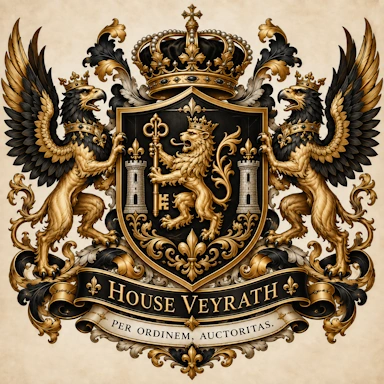
The official coat of arms represents House Veyrath as a whole.
Its primary symbols carry the following meaning:
The Crown represents continuity and the authority of the House.
The Lion represents leadership, courage, and executive responsibility.
The Key represents authority, access, and stewardship.
The Twin Towers represent the connection between past and future.
The Griffins represent protection, vigilance, and enforcement.
Black represents discipline and sovereignty.
Gold represents authority, dignity, and legacy.
Silver represents integrity and justice.
The coat of arms may not be altered, commercially exploited, or used to imply official authority without permission.
The Motto
The official motto of House Veyrath is:
Per Ordinem, Auctoritas.
Through Order, Authority.
The motto expresses the central philosophy of the House.
Authority does not arise solely from title, strength, wealth, or reputation.
True authority requires structure, responsibility, legitimacy, and continuity.
Discipline
Violations of this Charter may result in internal disciplinary measures.
Depending on severity, measures may include:
- informal warning
- formal warning
- restriction of privileges
- temporary suspension of rank
- removal from an executive position
- reduction of rank
- temporary suspension from House activities
- revocation of official representation rights
- removal from the Family Registry
Disciplinary decisions should be proportionate to the conduct involved.
Removal from the House should remain an exceptional measure reserved for serious or persistent violations.
Removal from the House
Membership may be revoked where a member has seriously violated the trust placed in them.
Grounds may include:
- deliberate betrayal of the House
- serious abuse of authority
- intentional reputational sabotage
- repeated unauthorized disclosure of confidential information
- fraudulent representation of the House
- severe harassment of other members
- continued refusal to comply with fundamental House rules
Removal must be formally recorded.
A removed member loses the right to represent themselves as an officially recognized member of House Veyrath.
Resignation
A member may voluntarily leave House Veyrath.
Resignation should be communicated to the House leadership and formally recorded.
A former member retains ownership of their personal property and independent enterprises.
However, they may no longer claim current rank, executive authority, or official representation of the House.
Succession
The continuity of House Veyrath shall not depend solely upon age or inheritance.
The successor to the Head of House should be capable of protecting and administering the family.
Succession may consider:
- family connection
- competence
- loyalty
- experience
- judgment
- acceptance within the House
- ability to preserve continuity
- understanding of Veyrath principles
The current Head of House may designate a successor.
Where no valid designation exists, senior members may determine succession according to established family procedure.
The interests of the House shall take precedence over personal ambition.
Amendments
This Charter is intended to remain stable, but it is not immutable.
House Veyrath may evolve as circumstances change.
Amendments may be proposed where existing rules no longer adequately serve the House.
Significant amendments require approval by the Head of House and may be reviewed by senior members or the appropriate executive body.
Historical versions of the Charter should be preserved in the family archive.
Final Principle
House Veyrath exists because its members choose to preserve it.
Its traditions provide identity.
Its structure provides stability.
Its members provide strength.
Its leadership provides direction.
No rank, title, company, or individual stands above the continued existence and integrity of the House itself.
Preserve what deserves to endure. Change what must evolve. Protect what belongs to the House.
House Veyrath
Per Ordinem, Auctoritas.