Our History
The origins of House Veyrath can be traced to the late eighteenth century, when the Veyrath name first appeared in regional records as a family associated with administration, trade, and the protection of privately held estates.
Unlike many noble houses of the period, Veyrath did not build its influence primarily through inherited titles or military conquest. Its position grew through organization, commercial discipline, and the ability to maintain stability in times of political and economic uncertainty. From its earliest years, the family became known for a simple principle: authority was only valuable when supported by structure.
This principle would eventually become the foundation of the House's identity.
Per Ordinem, Auctoritas. Through Order, Authority.
The First Generation
The formal establishment of House Veyrath is traditionally dated to 1794, when Edmund Veyrath consolidated several family properties, businesses, and financial interests under a single household administration.
Edmund rejected the fragmented structure common among wealthy families of his era. Instead, he introduced a centralized system in which property, commercial interests, succession, and family responsibilities were administered according to written rules.
The original Veyrath household was therefore more than a family residence. It operated as a small administrative institution.
The first family council was created during this period, consisting of senior relatives and trusted advisers. Although the head of the family retained final authority, important matters involving property, succession, finances, and external agreements were formally recorded and discussed.
This early structure became the foundation for what later generations would call the Veyrath Order.
The Nineteenth Century
Throughout the nineteenth century, House Veyrath expanded beyond its original estates.
Rather than pursuing a single industry, the family invested in several areas considered essential to long-term independence:
- property and land management
- transportation
- manufacturing
- finance
- legal services
- infrastructure
The family deliberately avoided dependence on any one business or institution.
By the middle of the century, members of House Veyrath were expected to contribute directly to the prosperity of the House. Some managed companies, others handled legal and financial affairs, while certain members were responsible for maintaining the family's internal administration.
During this period, the distinction between family and institution became increasingly important.
To be Veyrath was not simply to carry the name. Membership carried obligations.
Members were expected to protect the reputation of the House, respect its hierarchy, preserve its assets, and contribute to the stability of future generations.
The Veyrath Charter
In 1878, the growing complexity of the family resulted in the creation of the first formal Veyrath Charter.
The Charter defined the responsibilities of the family head, the rights of members, succession procedures, management of common assets, and the authority of the family council.
One principle stood above all others:
The House is greater than the individual who leads it.
The head of House Veyrath was therefore understood not as the owner of the family, but as its highest administrator and representative.
The assets, traditions, and authority of the House were considered an inheritance held in trust for future generations.
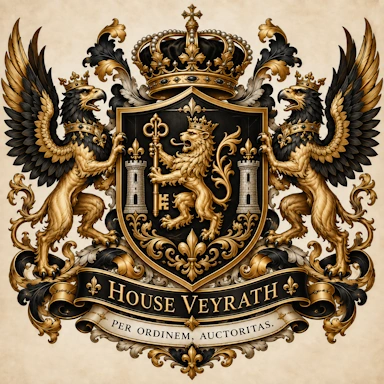
It was during this period that many symbols associated with House Veyrath began to appear in their modern form.
The crowned lion represented leadership.
The key represented authority and access.
The twin towers represented continuity between past and future.
The griffins represented protection and enforcement.
Black represented discipline.
Gold represented authority and dignity.
Silver represented integrity.
Together, these elements formed the basis of the modern Veyrath coat of arms.
The Industrial Era
The early twentieth century transformed the structure of House Veyrath.
Traditional estates became less important, while corporations, investments, and professional management became increasingly central to the family's influence.
Several Veyrath-controlled enterprises were reorganized into independent companies. The House itself gradually withdrew from direct commercial management and instead adopted the role of a central family authority overseeing shared interests.
This separation became an important Veyrath principle.
The House governs the family. The companies conduct business.
Individual members were permitted to establish and control their own enterprises, provided that such activities did not damage the reputation, security, or long-term interests of House Veyrath.
This system allowed the family to expand without turning every company into a direct extension of the House.
The Period of Consolidation
Following decades of expansion, the second half of the twentieth century became a period of consolidation.
House Veyrath reduced unnecessary holdings and reorganized its internal structure around three priorities:
Continuity. Independence. Control.
Family records were centralized.
Corporate interests were separated from personal property.
Succession procedures were standardized.
Senior positions within the House were defined more clearly.
The old family council gradually evolved into a modern executive body capable of dealing with financial, organizational, and internal matters.
This was also the period in which the modern understanding of Veyrath authority emerged.
Authority within the House was no longer based solely on seniority.
It depended on responsibility, position, trust, and service to the family.
The Modern House
By the beginning of the twenty-first century, House Veyrath had transformed from a traditional dynastic household into a modern private family institution.
Its influence no longer depended upon land or formal aristocratic privilege.
Instead, the House derived its strength from its members, companies, accumulated assets, internal organization, and long-established identity.
Modern House Veyrath operates through a structured hierarchy in which family membership, rank, responsibility, and commercial activity remain clearly documented.
The House maintains its own internal records, family registry, corporate registry, historical archive, and administrative structure.
While individual members retain considerable independence, matters affecting the entire House remain subject to the authority of its leadership.
The Veyrath Executive Tradition
One characteristic has remained consistent throughout Veyrath history: the House favors decisive administration over ceremonial leadership.
The head of House Veyrath is expected to act.
The position therefore combines the traditional role of a family head with the responsibilities of a modern executive.
The leadership is responsible for protecting the House, maintaining its internal structure, resolving disputes, recognizing members, supervising succession, and representing the collective interests of the family.
This philosophy is the reason the Veyrath motto has survived every major transformation of the House:
Per Ordinem, Auctoritas.
Authority does not exist merely because it is declared.
It exists because there is an order capable of supporting it.
The Akira Veyrath Era
The current era of House Veyrath began with Akira Veyrath, under whose leadership the family entered a period of modernization.
Akira retained the ceremonial traditions and historical identity of the House while restructuring its administration for the modern age.
Family records were digitized.
Membership and rank were formally documented.
The corporate registry was reorganized.
Historical documents were consolidated into a central archive.
A renewed distinction was established between personal relationships, family membership, and official positions within the House.
Under Akira, House Veyrath also adopted a more visible public identity.
The coat of arms was restored as the official symbol of the House, the historical motto was reaffirmed, and a modern administrative system was introduced to preserve Veyrath traditions without allowing them to become purely ceremonial.
The objective of this modernization was not to imitate the past.
It was to ensure that the House could continue to function in the future.
The Present
Today, House Veyrath exists as a private dynastic family built around heritage, structure, enterprise, and mutual responsibility.
Its members may pursue different professions, companies, and personal ambitions, but they remain connected through a common identity and a shared institutional framework.
The House does not define strength purely through wealth or status.
A Veyrath is expected to demonstrate loyalty, competence, discretion, and responsibility.
Rank represents responsibility rather than privilege.
Authority requires accountability.
Tradition must serve a purpose.
The modern House therefore continues to follow the principle established by its earliest generations:
Preserve what deserves to endure. Change what must evolve. Protect what belongs to the House.
House Veyrath remains a living institution rather than a monument to its own history.
Its past establishes its identity.
Its present defines its strength.
Its future will be determined by those who carry the name forward.
House Veyrath
Per Ordinem, Auctoritas.